The Big-Eared Blister Beetle
by Joseph and Nellie Kowalski
My wife, Nellie, called me out to the back yard to show me a strange-looking insect on the remains of one of the bushes that had died after the February 2022 winter storm. The creature conjured in me a strange combination of admiration of their festooned vivid colors, but also of their fearsome appearance. Their name is Cissites auriculata (Champion, 1892), commonly known as the Big-Eared Blister Beetle. Say that three times as fast as you can. Apparently, gravity is not a problem for them.
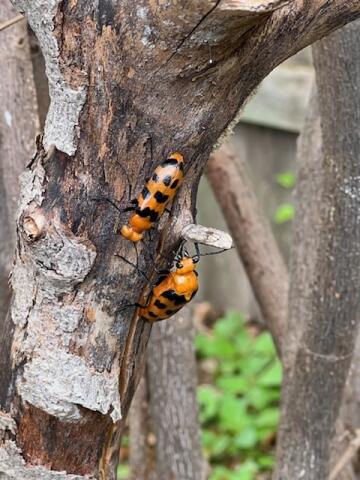
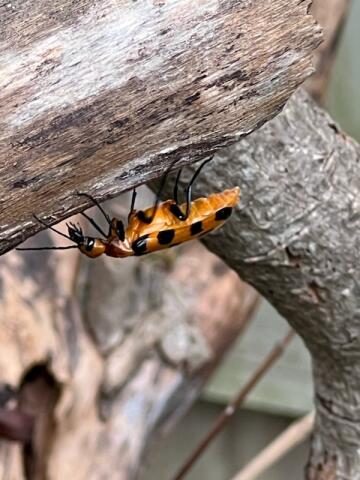
Blister Beetles are actually toxic enough to hurt the gardener as well as the garden. These pests are unwanted guests in any garden. Adult blister beetles eat leaves, flowers, and soft plant tissues. They consume a variety of plants including legumes, potatoes, and other crops. Larvae are parasitic, feeding on bee nests to consume eggs and larvae. The first larval stage, known as triungulin, attaches to a bee and gets transported to its nest where it feeds on bee eggs and larvae. The Blister Beetle produces many eggs. A single female can lay between 3,000 and 9,500 eggs every one-to-two weeks, as many as five or six times.
Blister Beetles are preyed upon by a wide variety of mammals, birds, reptiles, and frogs. The toxin is painful and a potent deterrent for any would-be predator that hasn’t evolved any protection against it. Those species that use bright colors as a warning to predators include some species of Blister Beetle and Poison Dart tropical frogs. This manner of warning is called “aposematism,” also be seen in some species of wasps and Lady Bugs.
The toxic part of the Blister Beetle is cantharidin. It is so effective at destroying tissue that it’s used in wart removal products. It is toxic if swallowed. These insects are not typically aggressive towards humans. If you can avoid contact with the beetles themselves, that’s best.
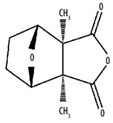
Structural formula of cantharadin
(https://www.planetnatural.com/pest-problem-solver/garden-pests/blister-beetle-control/)
Photos were taken by the author.
 All Things Biological